BUSINESS
Canada’s prime minister and Alberta’s premier have signed a pipeline deal that could reverse the province’s oil tanker ban. The agreement marks a major shift in national energy and environmental policy.
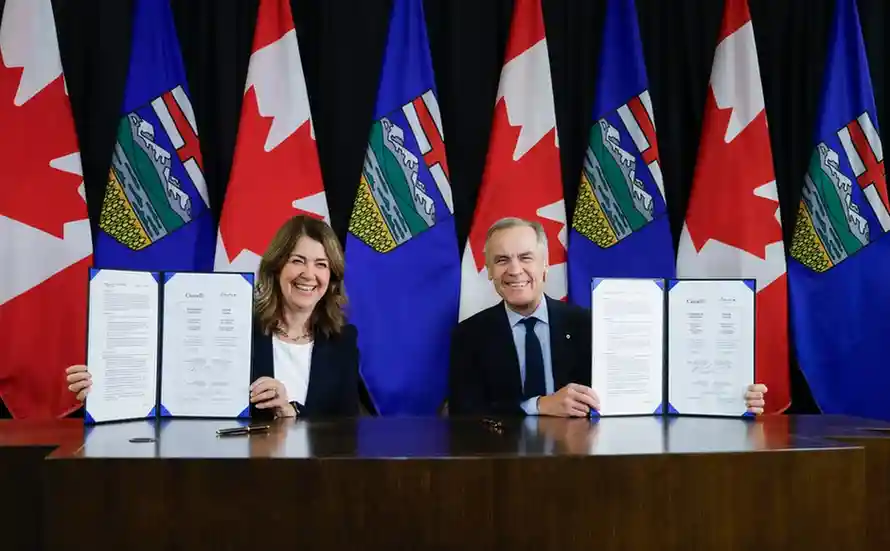
Canada’s prime minister and Alberta’s premier sign pipeline deal that could reverse oil tanker ban
Canadian Prime Minister Mark Carney and the premier of Alberta agreed Thursday to work toward building a pipeline to the Pacific Coast to diversify Canada’s oil exports beyond the United States, a move that has caused turmoil in Carney’s inner circle; the memorandum of understanding includes an adjustment of an oil tanker ban off parts of the British Columbia coast if the pipeline is built; Carney’s support led to the resignation of cabinet minister Steven Guilbeault, a former environment minister and longtime environmentalist serving as culture minister, who said he strongly opposes the agreement because the pipeline could cross the Great Bear Rainforest and increase the risk of tanker spills, though he will remain a Liberal Member of Parliament; Carney said he was glad Guilbeault is staying in the caucus; Carney has set a goal to double Canada’s non-U.S. exports in the next decade, arguing that American tariffs are dampening investment; Alberta Premier Danielle Smith said the agreement could eventually support over 1 million barrels per day for Asian markets so Canada is no longer dependent on a single buyer; Carney said the U.S.
transformation of trade relationships has turned Canada’s strengths into vulnerabilities, noting over 95% of energy exports go to the U.S., and said a pipeline would reduce the price discount on current sales; he emphasized the framework is only a starting point and that without a private sector proponent, the project will not proceed; the agreement calls on Ottawa and Alberta to work with British Columbia, where opposition to oil tankers is fierce; former Prime Minister Justin Trudeau approved one controversial pipeline to the B.C. coast in 2016 but rejected the Northern Gateway project through the Great Bear Rainforest, which would have shipped 525,000 barrels per day to Asia; northern Alberta has one of the world’s largest oil reserves at 164 billion barrels; Carney’s announcement came after B.C.
Premier David Eby warned that lifting the tanker ban would threaten existing projects and First Nations consensus, saying the proposed pipeline has no company, no funding and no coastal First Nations support; Coastal First Nations President Marilyn Slett said they have zero interest in any project that could destroy their way of life; the agreement pairs the pipeline with a proposed carbon capture project, and federal and provincial officials say both must be built together; Ottawa and Alberta will work with companies to identify new emissions-reduction projects by April 1 for rollout starting in 2027..

More News To Explore
IMF urges China to address economic imbalances as trade surplus hits $1 trillion