FINANCE
Asian markets fell sharply, with South Korea’s Kospi index dropping more than 5%, as investors reacted to global economic concerns, weak corporate earnings, and renewed geopolitical tensions in the region.
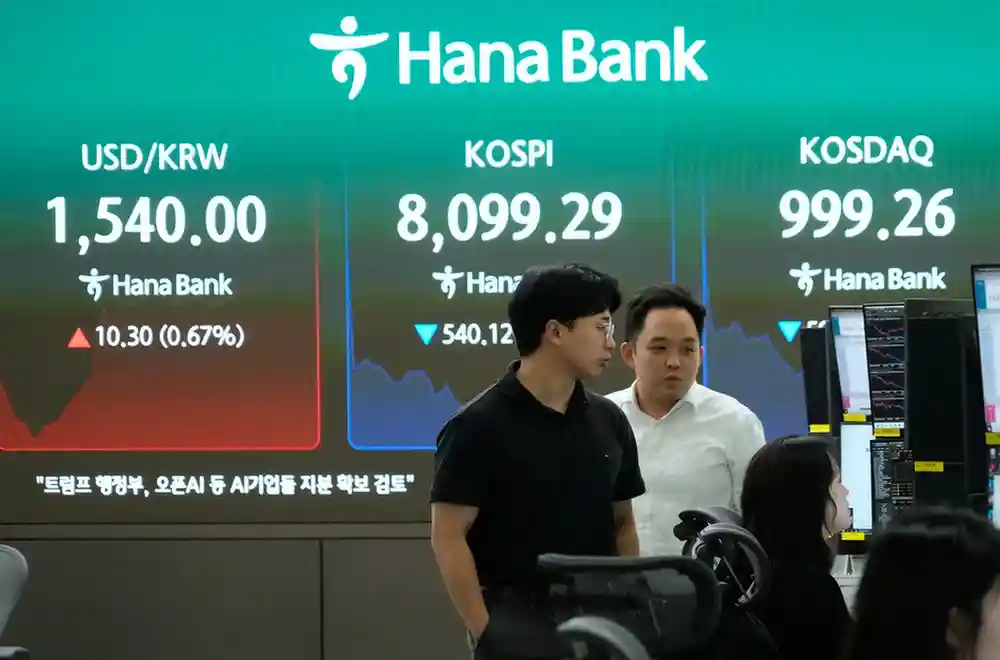
Asian Shares Slide as South Korea’s Kospi Plunges Over 5%
Asian equities tumbled across the board as investors grappled with a mix of economic uncertainty, disappointing corporate earnings, and geopolitical concerns, with South Korea’s Kospi index plummeting more than 5% in a single session, reflecting deep investor anxiety over slowing global growth, heightened volatility in U.S.
and European markets, and persistent fears surrounding supply chain disruptions, rising interest rates, and inflationary pressures in major economies, with analysts noting that the Kospi’s steep decline was driven not only by domestic concerns over weaker-than-expected export figures and disappointing corporate results in technology and manufacturing sectors but also by global sentiment, as investor risk appetite waned in response to soft economic data from China, uncertainty in energy markets, and ongoing tensions in key trade relationships that influence South Korea’s export-driven economy, while other major Asian indices, including Japan’s Nikkei 225 and Hong Kong’s Hang Seng, also registered losses, although more modest, as market participants weighed earnings reports, central bank policies, and currency fluctuations, and the sell-off saw a rotation out of growth and technology stocks into defensive sectors such as utilities, healthcare, and consumer staples, as investors sought safety amid the turbulence, with financial markets demonstrating heightened sensitivity to macroeconomic indicators such as manufacturing PMIs, trade balances, and employment figures that could signal slowing economic momentum, and analysts highlighted that foreign investors were net sellers in South Korea, further exacerbating the market drop, as capital outflows compounded domestic concerns over corporate earnings and valuation levels, while traders monitored the Bank of Korea and other regional central banks for potential policy adjustments, noting that any signals regarding interest rates, quantitative easing, or liquidity support could influence short-term market sentiment, with currency markets also affected as the Korean won weakened against the U.S.
dollar, reflecting both global risk-off sentiment and domestic economic uncertainty, and the broader Asia-Pacific region witnessed mixed reactions, as commodity-linked markets like Australia’s ASX faced pressure from falling metal prices, while Singapore and Taiwan experienced moderate declines driven by export-dependent sectors, emphasizing the interconnectedness of regional economies and the influence of global macroeconomic trends on local market performance, with analysts warning that the steep drop in the Kospi could trigger further volatility if global growth concerns persist or if corporate earnings continue to disappoint, potentially affecting investor confidence and capital flows across the region, and technical indicators suggested that the index might face additional downside pressure, with support levels being tested and market sentiment remaining fragile as geopolitical and economic developments evolve, highlighting the need for cautious positioning and risk management strategies by institutional and retail investors, while media coverage and market commentary emphasized the significance of South Korea’s market drop as a bellwether for broader Asian equity performance and the sensitivity of export-driven economies to external shocks, and the session concluded with investors digesting economic reports, corporate announcements, and central bank commentary that collectively underscored the fragile balance between growth prospects and downside risks, leaving market participants closely watching for policy responses, earnings guidance, and global economic data that could either stabilize the markets or prolong the current corrective phase, making the sharp decline in Asian shares, and particularly the Kospi, a key story for understanding regional market dynamics, investor behavior, and the interplay between domestic fundamentals and global economic forces in shaping short-term and medium-term equity trends across Asia-Pacific financial markets, and providing a lens into how market psychology, geopolitical developments, and macroeconomic indicators converge to influence investor sentiment, risk appetite, and capital allocation decisions in one of the most active and globally integrated market regions in the world..

More News To Explore
Asian Shares Follow Wall Street Lower as Bond Markets Intensify Global Pressure